
- Installation
How to Prepare Your Home for New Flooring Installation in Butte and Bozeman, Montana
April 10, 2026
Most flooring problems homeowners blame on the product actually start three days before the installer arrives. In Butte and Bozeman, where winter heating drops indoor humidity below 30 percent and basement slabs move moisture silently through concrete for months, how you prepare your home matters as much as which floor you choose.
The preparation phase is where floors are won or lost. Skip it, and you are setting up your new LVP, hardwood, or tile for a warranty conversation six months from now. Get it right, and your floor performs exactly the way it should for decades.
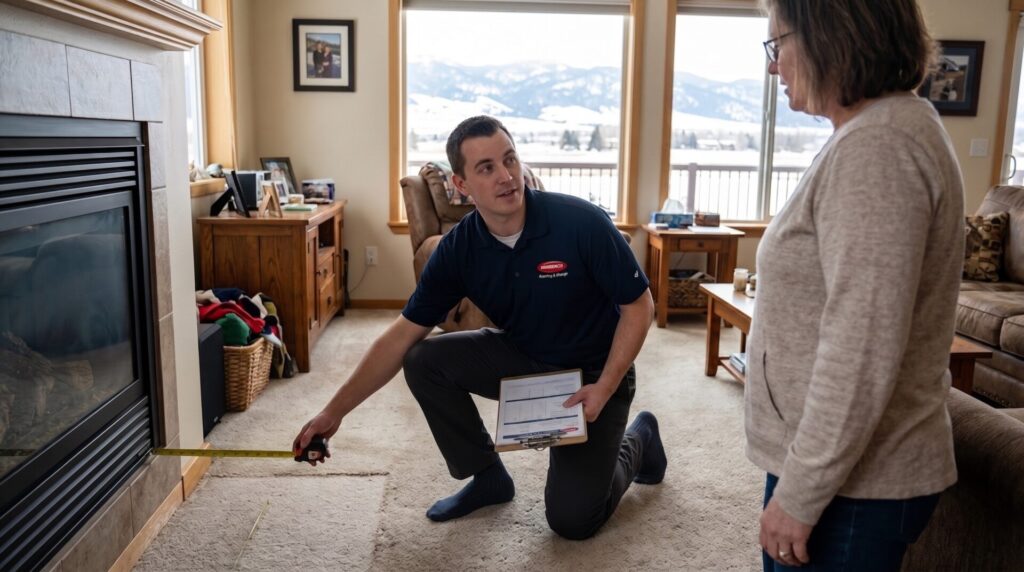
Ready to start planning? Get a free estimate from Pierce Carpet Mill Outlet in Butte at (406) 494-3313 or Bozeman at (406) 586-8234 and schedule a free in-home measurement with a flooring specialist before your project begins.
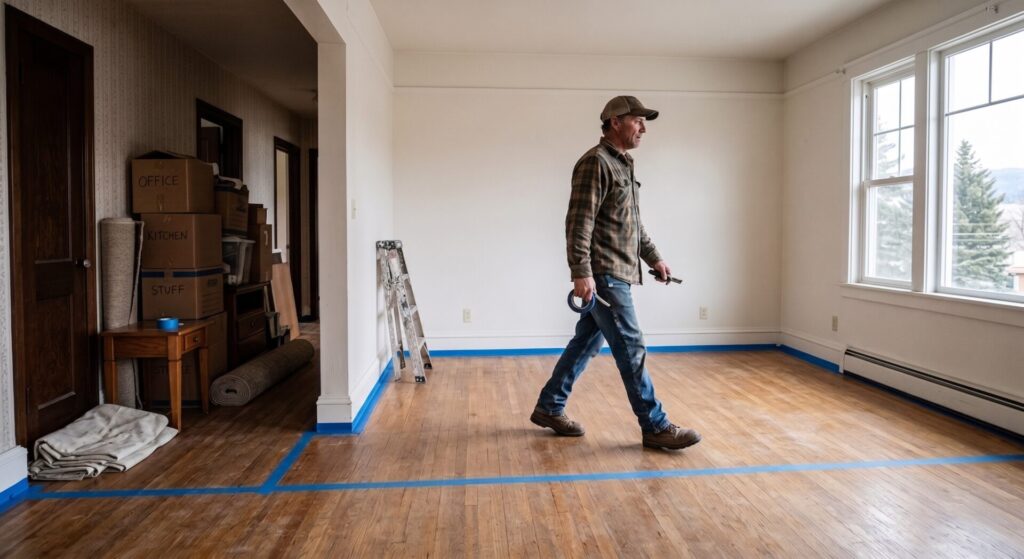
Why Preparing for Flooring Installation in Montana Is Different From Anywhere Else
Butte and Bozeman sit at elevations most of the country does not experience. Butte tops out at 5,538 feet above sea level. That elevation does two specific things to your flooring project that a national chain’s how-to guide will never mention.
First, indoor humidity in Butte drops hard in winter. Heated air at this altitude holds very little moisture. From November through March, relative humidity inside a Butte home routinely falls below 30 percent without a humidifier running — and during the coldest stretches, readings under 20 percent are common. By contrast, Bozeman winters are slightly more moderate but follow the same pattern. Summer relative humidity in both cities ranges from around 41 to 60 percent before climbing back toward 80 percent in winter.
That 40-point swing is a flooring variable. Wood expands when humidity rises and contracts when it drops. Solid hardwood, engineered hardwood, and even high-quality laminate all respond to that range. A floor installed in October without proper acclimation will behave completely differently by January. Planning your prep correctly before installation day accounts for this cycle.
Second, Butte sits on mining-legacy ground. Much of the city’s residential footprint covers soil with compacted clays and fill material from more than a century of underground and open-pit mining. That soil profile affects drainage. Moisture migrates slowly and unevenly through slab-on-grade concrete in these neighborhoods, particularly in the Uptown and Flats districts. The concrete looks dry. The moisture test tells a different story.
Bozeman presents its own wrinkle. The Gallatin Valley sees more spring snowmelt and higher spring humidity than Butte, and growth in the Belgrade corridor means newer homes built on concrete slabs over radiant heat systems are common. Flooring installed over radiant heat requires specific preparation and acclimation protocols that differ from standard slab installs.
Pro-Tip from the Pierce Carpet Mill Outlet Flooring Team:
In older Butte homes, particularly near the Uptown and Flats neighborhoods, we regularly see concrete subfloor moisture readings that exceed safe installation thresholds — even in homes that have looked dry for years. Before any glue-down or floating installation on a concrete slab in Butte, run a calcium chloride moisture test or an in-situ relative humidity probe. The test takes 72 hours and costs almost nothing compared to a warranty callback on a floor that cupped or adhesive-failed six months in.
What Does ‘Preparing Your Home for Flooring Installation’ Actually Mean?
Homeowners often assume preparation means moving furniture. That is one piece of it, but only one. Real preparation covers five areas: room clearing and access, subfloor assessment, climate control, material acclimation, and protecting the rest of your home during the work.
1. Clear the Room Completely and Plan for Access
Your installation crew cannot work around furniture. Every item in the room being floored needs to come out before the crew arrives — not partially moved, not stacked in the corner. If your installer has to work around obstacles, they are not focused on the floor.
For large appliances like refrigerators, dishwashers, and stoves, confirm with your installer ahead of time who is responsible for moving them. Some crews include appliance handling; others do not and charge extra. Asking in advance saves a last-minute scramble.
Pets need a plan too. Flooring installations involve adhesives, solvents, and unfamiliar people coming in and out of doors. A dog or cat loose during installation creates both a safety issue and a risk to the wet floor. Plan for pets to be in a closed room, outside, or at a neighbor’s for the duration.
2. Assess and Address Your Subfloor
Your subfloor is the foundation your new floor lives on. No matter how good the product is, a bad subfloor produces a bad floor. This is the step most homeowners underestimate, and it is where most callbacks originate.
The two things your subfloor must be: flat and dry. Not level — flat. According to the
The two things your subfloor must be: flat and dry. Not level, flat. According to the Resilient Floor Covering Institute (RFCI), LVP and SPC products require no more than 3/16 of an inch variation over a 10-foot span. Wide-plank hardwood is even less forgiving. If your slab has bumps, dips, or ridges that exceed that tolerance, they need to be ground down or filled with self-leveling compound before the first plank goes in. In older Butte homes on slab-on-grade construction, this step frequently adds $1.50 to $3.00 per square foot to the project. Budget for it.
Moisture is the other critical variable. Ask your Pierce representative about moisture testing before your project is finalized. Calcium chloride tests for concrete slabs and in-situ relative humidity probes are both standard approaches. A reading above the manufacturer’s threshold is not a reason to panic, but it is a reason to add a vapor barrier. Skipping this step on a Butte slab is how you get cupped hardwood or adhesive failure in engineered flooring.
For homes with plywood subfloors, walk the room and listen for squeaks before your crew arrives. A squeak is a loose fastener or a gap. Your installer can address it, but telling them in advance is faster and cleaner than discovering it under a new floor.
3. Control Your Home’s Climate Before and During Installation
Material acclimation is one of the most misunderstood steps in the process. Most flooring products need time to adjust to the temperature and humidity of your home before installation begins. Engineered hardwood typically requires 48 to 72 hours of acclimation in the room where it will be installed. Solid hardwood may need longer.
The National Wood Flooring Association (NWFA) recommends maintaining interior temperatures between 60 and 80 degrees Fahrenheit and relative humidity between 35 and 55 percent during wood flooring installation and for a reasonable period afterward. In Butte’s winter months, that humidity floor of 35 percent is genuinely difficult to maintain without a whole-home humidifier or portable units running in the space. If your home does not have one, talk to your installer about what to expect.
For LVP and SPC flooring, acclimation requirements are less strict because the material is dimensionally stable. But the room should still be at the installation temperature before the first plank goes down. A room that is 45 degrees during installation and 70 degrees by next week will produce expansion gaps if the product was not given time to adjust. This is especially relevant in Bozeman, where spring projects often start in cool conditions that warm quickly.
HVAC should be running normally during installation. Do not turn off your furnace or air conditioner the day before to save energy. The system is regulating the climate your floor is acclimating to, and disrupting it changes the variables.
4. Protect the Rest of Your Home
Dust from subfloor grinding, old flooring removal, and cutting new planks travels. Seal HVAC vents in the work area with plastic sheeting or tape to prevent debris from circulating through your system. Close doors to adjacent rooms.
Remove or cover anything in adjacent areas that cannot tolerate fine dust, including electronics, artwork, and open shelving. The cutting station for flooring material should be set up outside or in a garage when possible.
For tile installations, grout haze is real. If tile is being installed in a kitchen or bathroom that connects to carpeted areas, protect the carpet edge at the doorway. Grout tracked on carpet is a restoration project.
The employees of Pierce Carpet Mill Outlet are knowledgeable, communicative, respectful and flexible enough to work with my schedule. Selection of carpet, estimate and measurements, explanation and review of contract and installation all went well. I give a shout out to Jorge who installed the carpet. He takes pride in his work, was respectful of coordinating with our needs and is efficient. He meticulously prepared the surface, measured and cut the carpet and worked diligently to leave our home clean .
Cheryl B.
What Does It Cost to Install New Flooring in Butte and Bozeman?
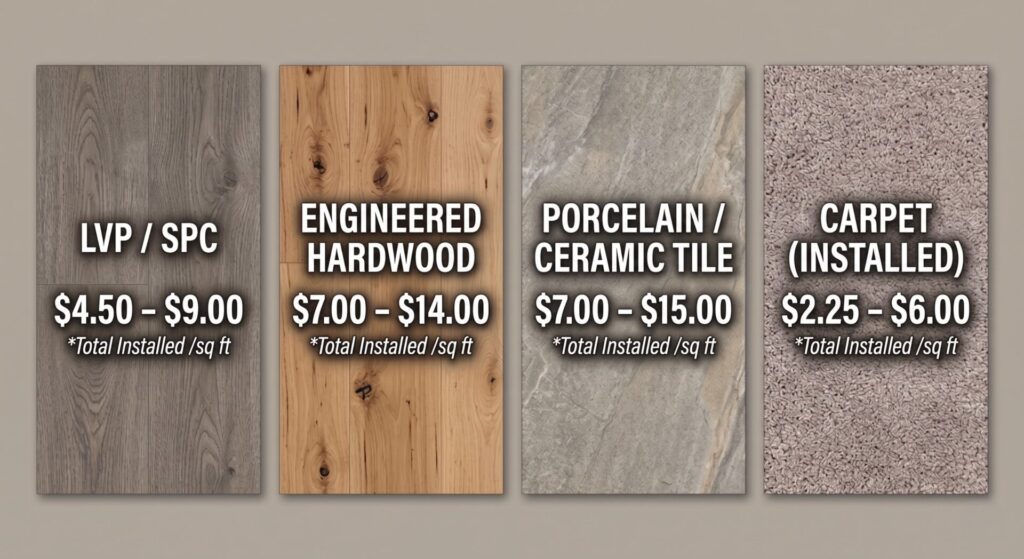
Montana flooring costs run higher than national averages for a few reasons: shipping distance to a landlocked mountain state, regional labor rates, and the subfloor preparation work that flat-rate online calculators never include. The table below reflects installed cost ranges for typical residential projects sourced through Pierce Carpet Mill Outlet in Butte and Bozeman.
| Flooring Type | Material /sq ft | Labor /sq ft | Total Installed | Local Notes (Butte/Bozeman) |
|---|---|---|---|---|
| LVP / SPC | $2.50–$5.50 | $2.00–$3.50 | $4.50–$9.00 | Older Butte slabs often need grinding + self-leveling compound; adds $1.50–$3.00/sq ft |
| Engineered Hardwood | $4.00–$9.00 | $3.00–$5.00 | $7.00–$14.00 | Vapor barrier required on slabs; adds $0.50–$1.00/sq ft. Acclimate 72+ hrs before install in winter |
| Porcelain / Ceramic Tile | $2.00–$6.00 | $5.00–$9.00 | $7.00–$15.00 | Large-format tile adds 20–30% to labor; longer cure time in Butte’s dry air (low humidity slows mortar set) |
| Waterproof Laminate | $1.50–$4.00 | $2.00–$3.50 | $3.50–$7.50 | Above-grade only; not warranted on concrete slabs by most manufacturers |
| Carpet (installed) | $1.50–$4.50 | $0.75–$1.50 | $2.25–$6.00 | Moisture-rated pad adds $0.30–$0.60/sq ft; worth it in older Butte homes with unfinished concrete basements |
| Sheet Vinyl | $1.25–$3.00 | $1.50–$3.00 | $2.75–$6.00 | Solid choice for utility rooms and rentals; must be glued over smooth, flat subfloor — no hiding bumps |
Source: Montana contractor market data, RSMeans 2025 construction cost index, and direct regional observation. Confirm current pricing with your Pierce representative. | View our flooring options
The single biggest driver of cost variation in both Butte and Bozeman is subfloor condition. A contractor who bids without walking your subfloor is guessing. In Butte especially, older concrete slabs with uneven surfaces add real dollars to the project. Knowing this before you sign an estimate protects you from surprises on installation day.Want a quote built around your actual space? Visit our showrooms in Butte or Bozeman this week — no appointment needed for in-store consultations — or call ahead to schedule a free in-home measurement.
What to Do in the Days and Weeks After Your New Floor Is Installed
The first 30 days after installation are when homeowners make the mistakes that show up six months later. Here is what the maintenance phase actually looks like in Montana’s climate.
Floors You Should Not Touch Immediately
For glue-down vinyl or LVP, avoid wet mopping for the first week. The adhesive needs time to cure fully, and excess moisture at the seams during that window can cause edge swelling. Dry mopping and light dry sweeping are fine.
For tile, grout cure time runs 24 to 72 hours before light foot traffic and up to 28 days before heavy use or wet mopping, depending on the grout type. Ask your installer what was used and follow the manufacturer’s cure schedule. Butte’s dry air in winter actually slows grout curing slightly compared to higher-humidity climates, so give tile a little extra time.
For hardwood, the floor needs to reach a settled equilibrium with your home’s humidity. Light cleaning is fine, but hold off on any water-based cleaning products for the first week, and keep foot traffic light for the first 24 hours.
The Humidity Maintenance Rule
Montana’s heating season creates a genuine floor maintenance challenge. According to the NWFA’s wood flooring care guidelines, the acceptable interior humidity range for hardwood floors is 35 to 55 percent. Butte’s heated homes drop below 35 percent from November through March without active humidification. If you have hardwood and no humidifier, plan for seasonal gapping. Those gaps are not a defect — they are the floor responding correctly to the environment. They close back up when humidity returns in spring.
For homeowners who want to prevent that movement, a whole-home humidifier set to 40 to 45 percent through the heating season is the most effective tool. Portable room humidifiers work in a pinch but require consistent monitoring.
LVP and SPC floors do not gap the way wood does, but the room’s climate still matters. The RFCI notes that extreme temperature swings can cause click-lock joints to loosen in floating installations. Keep your home’s temperature stable through Montana’s winter-to-spring transition. Rapid warm-up in late March when you open windows while the heat is still running is the scenario most likely to create a joint separation in a floating LVP installation.
The Cleaning Products That Shorten Floor Life
The most common maintenance mistake in Montana homes is using whatever cleaning product is under the sink. Steam mops on LVP, hardwood, or laminate force moisture into click-lock joints and cause swelling. Alkaline commercial cleaners degrade vinyl wear layers over time. Bleach-based products discolor grout.
For every flooring type, use a pH-neutral cleaner approved by the manufacturer. This single switch extends the life of your floor more than anything else you can do after installation.
Jodi was great. She was very patient as we tried to find the laminate that my wife and I could agree on. She printed off pages of installation instructions and cleaning options. She kept us updated and the flooring we ordered arrived in only a couple days. Chris was great as well. He loaded the pallet of flooring quickly and took care not to damage the tailgate on my truck. Customer service is very important to us and we were treated great by everyone.
Rob S.
How to Evaluate Any Flooring Installer in Butte or Bozeman
The preparation checklist above only works if the installation crew knows how to act on it. Here is what to ask any flooring company before you commit.
- Ask whether they conduct a site visit before finalizing your quote. A company that quotes you based on square footage alone, without walking your subfloor, is skipping the most important variable in your project.
- Ask specifically about moisture testing. What method do they use on concrete slabs? Do they test before ordering material? A professional crew answers this question without hesitation.
- Ask what happens if subfloor preparation adds cost. A transparent company tells you upfront that grinding or self-leveling compound may be needed and gives you a conditional estimate that accounts for it.
- Ask about warranty coverage for installation errors. The Pierce Promise covers installation errors with a one-year warranty and supports manufacturer defect claims for the life of the product. Ask any company you consider how they handle a problem that shows up three months after install.
Red flags in any flooring quote: no site visit, no mention of subfloor prep, vague warranty language that excludes installation workmanship, and lead times quoted as ‘approximate’ without a confirmed ship date.
Pierce Carpet Mill Outlet has operated under the Pierce’s Flooring Inc. umbrella since 1924, with over 230 employees across eight Montana locations. Certified craftsmen handle all installation work, and every project is backed by the Pierce Promise warranty program. The team at both the Butte and Bozeman locations knows what Montana subfloors actually look like — that local knowledge is part of what you get when you work with a flooring company that has been in this state for a century.
Frequently Asked Questions About Preparing for New Flooring in Montana
How much does it cost to install new flooring in a typical Butte or Bozeman home?
Installed costs for the most common flooring types range from $2.25 to $6.00 per square foot for carpet, $4.50 to $9.00 for LVP or SPC, $7.00 to $14.00 for engineered hardwood, and $7.00 to $15.00 for porcelain tile. The number that moves most dramatically is subfloor preparation: in older Butte homes on concrete slabs, grinding and self-leveling compound can add $1.50 to $3.00 per square foot before material is ordered. Get a site visit and a written estimate that accounts for subfloor condition before you lock in a budget.
How does Butte’s climate affect how I should prepare for flooring installation?
Butte’s high-altitude climate creates two specific preparation challenges. First, indoor humidity drops dramatically in winter — often below 30 percent without humidification — which requires longer acclimation times for wood-based flooring products. Second, the mining-legacy soil under many Butte properties causes uneven moisture migration through concrete slabs, which means moisture testing is not optional in this city. Running a calcium chloride test or in-situ relative humidity probe before installation protects you from adhesive failure and cupping.
What is the process from first call to finished floor with Pierce Carpet Mill Outlet?
Contact either the Butte location at (406) 494-3313 or Bozeman at (406) 586-8234. A Pierce specialist will discuss your project, confirm in-stock product availability, and schedule a free in-home measurement. At the measurement, your subfloor will be assessed and your installer will flag any preparation needs before material is ordered. Once material is confirmed and in-stock, your installation date is set. Most residential projects take one to three days depending on square footage and floor type.
When can I move furniture back into the room after new flooring is installed?
For LVP and SPC floating installations, light furniture can typically return within 24 hours. For glue-down installations, wait at least 24 to 48 hours and confirm with your installer based on the adhesive used. Tile requires 24 to 72 hours before light traffic and up to 28 days for full grout cure before heavy use or wet mopping. For hardwood, light furniture return is generally fine after 24 hours, but avoid dragging heavy pieces across the surface and use felt pads under all legs before moving anything back.
What is the biggest preparation mistake Montana homeowners make before a flooring installation?
Skipping moisture testing on concrete slabs. It is the most common, most preventable, and most expensive mistake in this region. Homeowners see a dry-looking slab and assume the moisture risk is low. In Butte especially, where soil conditions and slab construction history create slow moisture migration, the slab can look perfectly dry while testing above safe installation thresholds. A $40 calcium chloride test or a 72-hour in-situ probe answers the question definitively. Skipping it is how you end up with cupped hardwood or adhesive failure on a job that otherwise went perfectly.
Ready to Prepare for Your Flooring Project?
The right preparation turns a flooring installation into a straightforward project. The wrong preparation — skipped moisture tests, furniture in the way, no climate plan — turns a new floor into a callback.
Pierce Carpet Mill Outlet carries in-stock inventory across all major flooring categories at both the Butte and Bozeman locations. Free in-home measurements include a subfloor assessment, so you know what preparation is needed before material is ordered. Every project is backed by the Pierce Promise warranty program.
BUTTE LOCATION
800 Dewey Blvd, Butte, MT 59701
(406) 494-3313 | Toll-Free: 800-288-8943
BOZEMAN LOCATION
8334 Huffine Lane, Bozeman, MT 59718
(406) 586-8234 | Toll-Free: 800-726-8234
Stop in at either location this week — no appointment needed for in-store consultations. For a free in-home measurement, call either location directly. The team is there Monday through Friday and Saturday mornings.
You Might Also Like
Looking for Great Flooring Deals & Expert Service?
Save Big With Montana’s Trusted Flooring Experts