
- Flooring
What Is the Best Flooring for Radiant Heat? What Bozeman Homeowners Need to Know
July 22, 2026
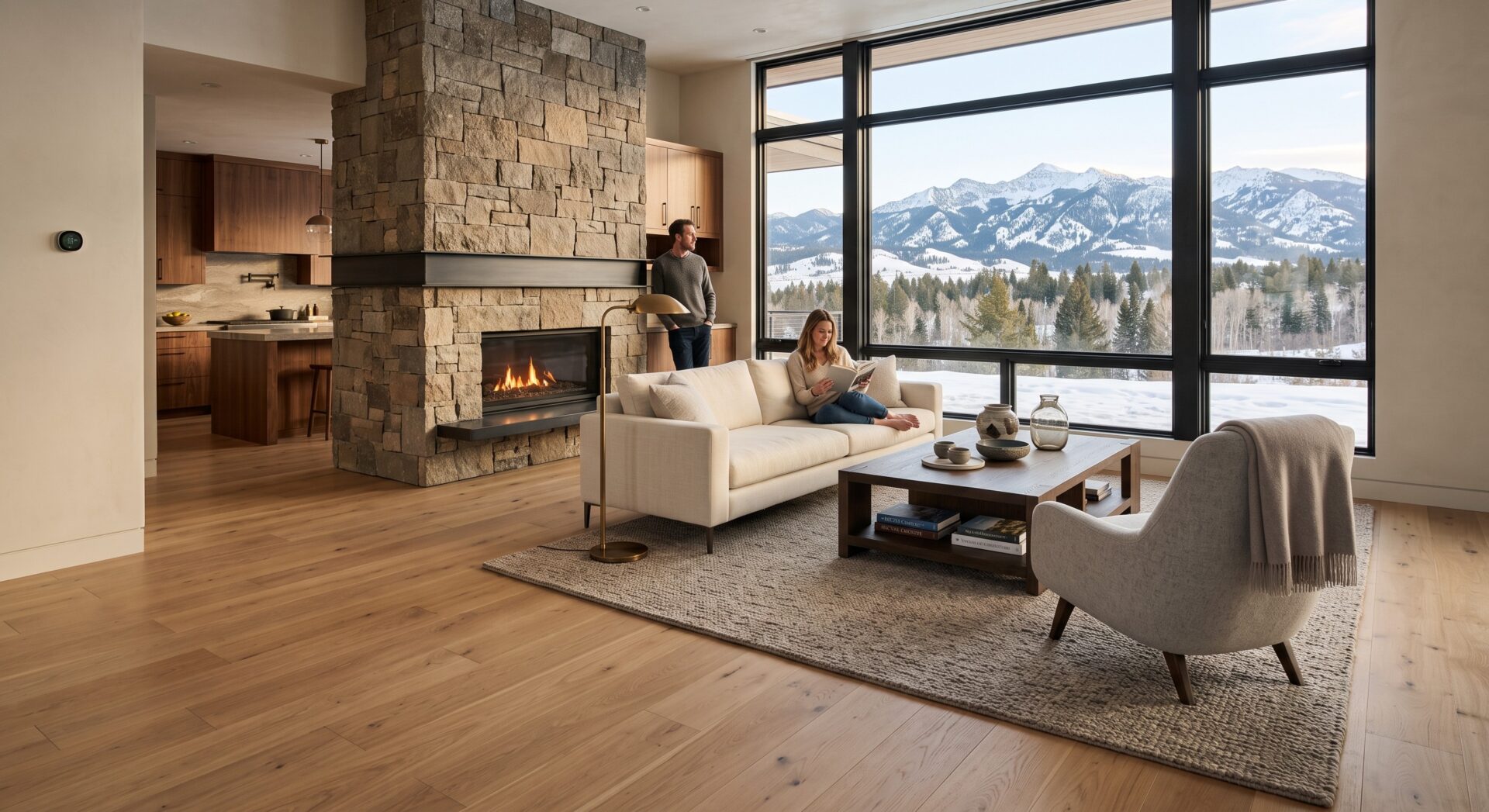
In the Gallatin Valley, in-floor radiant heat is no longer a luxury feature reserved for Big Sky ski lodges. It shows up routinely in the wave of custom homes and high-end remodels that have transformed neighborhoods from Four Corners to Bridger Canyon since 2020. And every time a homeowner with a hydronic system decides to replace their floors, the same question comes up: which floors actually work over radiant heat, and which ones will void the warranty or, worse, damage the system? The team at Pierce Carpet Mill Outlet on Huffine Lane works through this question regularly. Call (406) 586-8234 or stop in to talk through your specific setup before you buy anything.
Key Takeaways
- Tile and natural stone are the best flooring for radiant heat. They conduct heat efficiently and have no meaningful temperature limit for residential systems.
- Radiant-approved engineered hardwood works well over hydronic systems. The NWFA recommends keeping floor surface temperatures at or below 80 degrees Fahrenheit for wood.
- LVP is compatible with radiant heat only when the specific product carries a manufacturer radiant-heat rating. The surface temperature limit for vinyl is 85 degrees Fahrenheit.
- A floor-sensor thermostat is not optional with LVP or engineered hardwood over radiant heat. It is the control that keeps surface temps within warranty spec.
- Pierce Carpet Mill Outlet at 8334 Huffine Lane in Bozeman carries radiant-rated engineered hardwood lines including Kahrs and Duchateau, and helps homeowners verify compatibility before any product is ordered.
Why Radiant Heat Is Common in Bozeman Homes
Long winters and subzero stretches have made Bozeman hydronic country for generations. A heating season that can run from October to May, combined with the Gallatin Valley’s steady growth since 2020 and an influx of buyers who arrived expecting modern comfort systems, has made in-floor radiant heat one of the standard specifications in new Bozeman construction.
Most of these systems are hydronic: PEX tubing embedded in a concrete slab or gypcrete pour, fed by a boiler, delivering even, draft-free heat from the floor up. Electric radiant mats exist, mostly in bathrooms and tile areas, but when people in Bozeman say radiant heat, they usually mean hydronic.
Here is the thing that matters for flooring: the floor you install is not just a surface. Over a radiant system, it is part of the thermal envelope. Its thickness, its conductivity, and its R-value all affect how the system performs. Pick the wrong floor and you block the heat, stress the boiler, and risk damaging the flooring itself.
Pro Tip from the Pierce Carpet Mill Outlet Bozeman team:
Ask your flooring supplier for the specific product’s R-value and radiant-heat approval documentation before you order. In our Bozeman showroom, we pull the spec sheet and manufacturer installation guide for every product a customer is considering for a radiant floor. If the documentation does not confirm approval, we do not recommend it for that application.
What Is the Best Flooring for Radiant Heat?
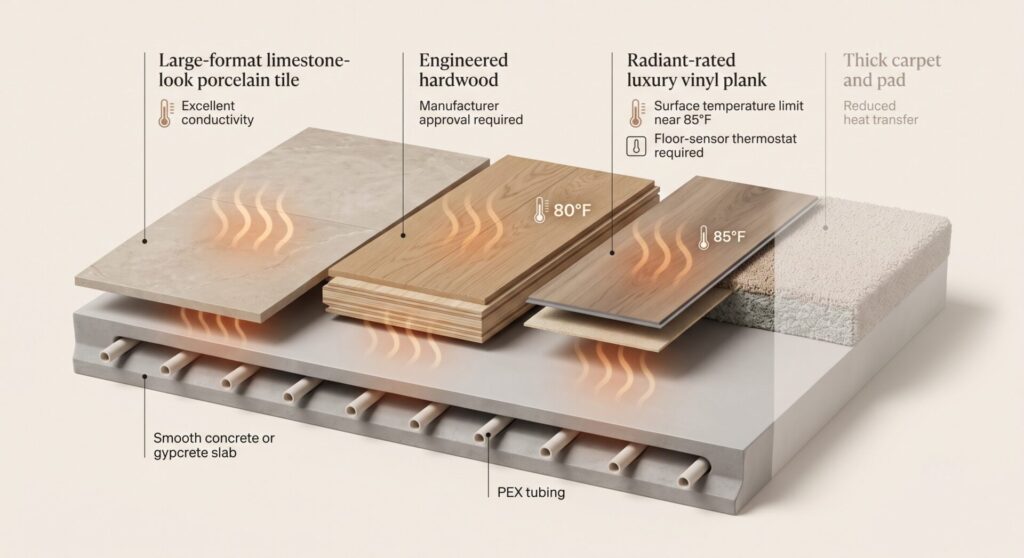
Tile and natural stone are the best flooring for radiant heat. They conduct heat efficiently, expand minimally with temperature changes, and have no meaningful upper temperature limit for residential systems. Porcelain, ceramic, and natural stone over a properly designed slab deliver the most efficient, durable radiant-heat floor you can buy.
The one radiant-and-tile caution worth knowing: the system must be switched off during the full cure time of the tile mortar after installation, then brought back up gradually, no more than about 5 degrees Fahrenheit per day, to avoid thermal shock to the grout joints. See the Tile Council of North America guidelines for slab-to-tile installation detail.
Engineered hardwood is the right wood choice for radiant heat. Its cross-grain construction resists the wood movement that solid planks experience under thermal cycling. Brands like Kahrs and Duchateau, carried at the Pierce Bozeman showroom, publish their radiant-heat ratings and installation requirements. The National Wood Flooring Association recommends keeping the floor surface temperature at or below 80 degrees Fahrenheit for wood floors. Glue-down is the preferred installation method over hydronic systems; floating adds thermal resistance and the combined R-value of the underlayment and flooring must stay at or below R-2.0.
Honestly, the assumption that all engineered hardwood is safe over radiant heat is wrong. The product must be explicitly approved by the manufacturer for that application. Not every engineered line is. Verify before you order.
Radiant-rated LVP is a practical option for bathrooms, utility rooms, and lower-level areas. The surface temperature limit for vinyl is 85 degrees Fahrenheit, and a floor-sensor thermostat is required to keep temps within spec. The spec sheet for your specific product is the controlling document, not a general online guide.
Standard carpet and thick pad block heat. The insulating effect of dense foam cushion prevents efficient heat transfer and forces the system to run hotter and longer to reach the thermostat setpoint. Thin commercial-style carpet or Berber with minimal pad can be used when carpet is needed over radiant heat. Deep-pile residential carpet with thick cushion is generally incompatible with radiant efficiency.
| Flooring type | Radiant compatibility | Key requirement |
| Porcelain and ceramic tile | Excellent. Best conductor, no temp limit | Off during mortar cure; gradual startup |
| Natural stone | Excellent. High conductivity, stable | Same as tile; check for hot spots near manifold |
| Radiant-approved engineered hardwood | Good with conditions | Mfr radiant rating; glue-down preferred; surface under 80 F; R-2.0 system cap |
| Radiant-rated LVP | Good with conditions | Mfr radiant rating required; surface under 85 F; floor-sensor thermostat mandatory |
| Thin Berber or commercial carpet | Limited | Minimal pad only; expect reduced system efficiency |
| Thick residential carpet and dense pad | Poor | Blocks heat; not recommended for most radiant systems |
| Solid hardwood | Not recommended | Excessive movement under thermal cycling in Bozeman’s dry climate |
“Charles was amazing! From measuring, picking a product to installation it was less than a month. The product had to be sourced from other locations too. The installer was incredible as well. I value communication and Charles was responsive even on his days away from the store. He had co workers chip in to keep the process moving and was prompt with refunding $ for work we did ourselves that was already figured into the quote. Smoothest and easiest part of our remodel. Very happy with the whole process. Thank you!!!”
Molly G., Bozeman – Flooring remodel (Charles Cunningham, Project Manager)
How Does Bozeman’s Dry Climate Affect Radiant-Heat Flooring?
Radiant heat and Bozeman’s winter air work against wood together. A hydronic system running hard through January pushes surface temperatures toward the upper limit of what engineered hardwood tolerates while the heating season simultaneously drops indoor humidity below 30 percent relative humidity in many homes.
Wood movement in a dry, heated environment is the mechanism behind most radiant-heat wood failures in the Gallatin Valley. The NWFA’s radiant heat guidelines emphasize that humidity control is as critical as temperature control when wood floors go over radiant systems. Running a whole-home humidifier during heating season is not optional in Bozeman if you want wood to perform.
Tile and radiant-rated LVP sidestep the humidity issue entirely. For homeowners who want real wood, that humidity conversation is part of the product selection process, not an afterthought.
What Should You Ask Your Flooring Installer Before Work Starts?
A Bozeman contractor was criticized in reviews for shooting nails through a customer’s radiant tubing while installing flooring. That kind of mistake is expensive and completely avoidable with the right pre-install process. Before any flooring goes down over your radiant system:
- Ask whether the installer has documentation of the radiant tubing layout. On hydronic slabs, a photo or drawing of the PEX layout prevents fastener accidents.
- For wood installations, ask whether the system has been running for at least 14 days before install. That drying period is required by most wood manufacturers and the NWFA.
- Ask which installation method they plan to use: glue-down, floating, or nail-down. Nail-down and staple-down are incompatible with slab-embedded radiant systems.
- Ask for the specific product’s radiant-heat approval documentation. If they cannot produce it, consider that a red flag.
In our experience, these conversations take about five minutes before a job, and they prevent the kind of failures that take weeks to resolve. Pierce Carpet Mill Outlet’s Bozeman team, including Store Manager Marc Avalos and Project Managers Charles Cunningham, Brandalyn Adair, Jason Moreland, and Ragan Montero, coordinates these details as part of every radiant-heat flooring project. Our installers are licensed and insured and backed by the Pierce Promise single-point warranty program. Pierce Carpet Mill Outlet has been part of Montana’s largest family-owned flooring network since 1924 and is a member of the National Floorcovering Alliance.
“Everyone was professional from the initial visit to installation. Quick to get on the installation schedule.”
Katie R., Bozeman – Flooring installation
Frequently Asked Questions
What is the best flooring for radiant heat?
Tile and natural stone are the top performers over radiant heat. They conduct heat efficiently, expand minimally, and have no meaningful temperature ceiling. Radiant-approved engineered hardwood is a close second, especially for main living areas where the warmth of real wood matters. Radiant-rated LVP is a practical choice for utility rooms, basements, and bathrooms. Standard thick carpet and dense pad block heat transfer and are not a good fit for most radiant systems.
Can you put LVP over radiant floor heat?
Yes, but only with a product that carries a manufacturer radiant-heat rating. The surface temperature must stay at or below 85 degrees Fahrenheit. A floor-sensor thermostat is required, not optional, to keep surface temps within spec. Check the product spec sheet before you buy, not after.
Can you put hardwood floors over radiant heat?
Engineered hardwood, yes, with conditions. The product must be manufacturer-approved for radiant heat. The National Wood Flooring Association recommends keeping the floor surface at or below 80 degrees Fahrenheit. Glue-down installation is preferred over floating because a floating underlayment adds thermal resistance; the combined R-value of underlayment and flooring must stay at or below R-2.0. Solid hardwood is generally not recommended over hydronic systems in Bozeman’s dry climate.
Does thick carpet work over radiant heat?
Standard residential carpet with a thick foam pad acts as insulation over a radiant system, blocking heat transfer and forcing the boiler to work harder. Thin commercial-style carpet or Berber with minimal pad can be used when carpet is needed. Deep-pile broadloom with dense cushion is generally not compatible with radiant-heat efficiency.
How long should you run radiant heat before installing flooring?
Run the radiant system for a minimum of 14 days before any wood flooring is installed. This dries and acclimates the slab and equalizes moisture content in the subfloor. For tile, the system must be off during the full mortar cure period, then brought back up gradually in increments of no more than 5 degrees Fahrenheit per day.
Get the Right Floor for Your Radiant System in Bozeman
Getting the product right on a radiant-heat floor protects both your investment and the heating system under it. Pierce Carpet Mill Outlet is at 8334 Huffine Lane in Bozeman, open Monday through Saturday. Call (406) 586-8234 or request a free in-home measure. Our project managers will pull the spec sheets for any product you are considering and walk through your system setup before we recommend anything.
Before your visit, try floors in a photo of your room using the Roomvo room visualizer on our website. It is a useful way to narrow the field before you come in and compare real samples.
You Might Also Like
-

- Flooring
October 13, 2026
How Do You Know When to Replace Carpet? 7 Signs Butte Homeowners Should Not Ignore
-
- Flooring
October 7, 2026
What Is the Best Waterproof Flooring for Kitchens? A Bozeman Buyer’s Guide
-
- Flooring
October 6, 2026
Nylon vs. Polyester Carpet: Which Fiber Lasts Longer in a Busy Montana Home?
Looking for Great Flooring Deals & Expert Service?
Save Big With Montana’s Trusted Flooring Experts