
- Flooring
Why Do Hardwood Floors Get Gaps in Winter? Montana’s Dry Climate Explained
July 29, 2026
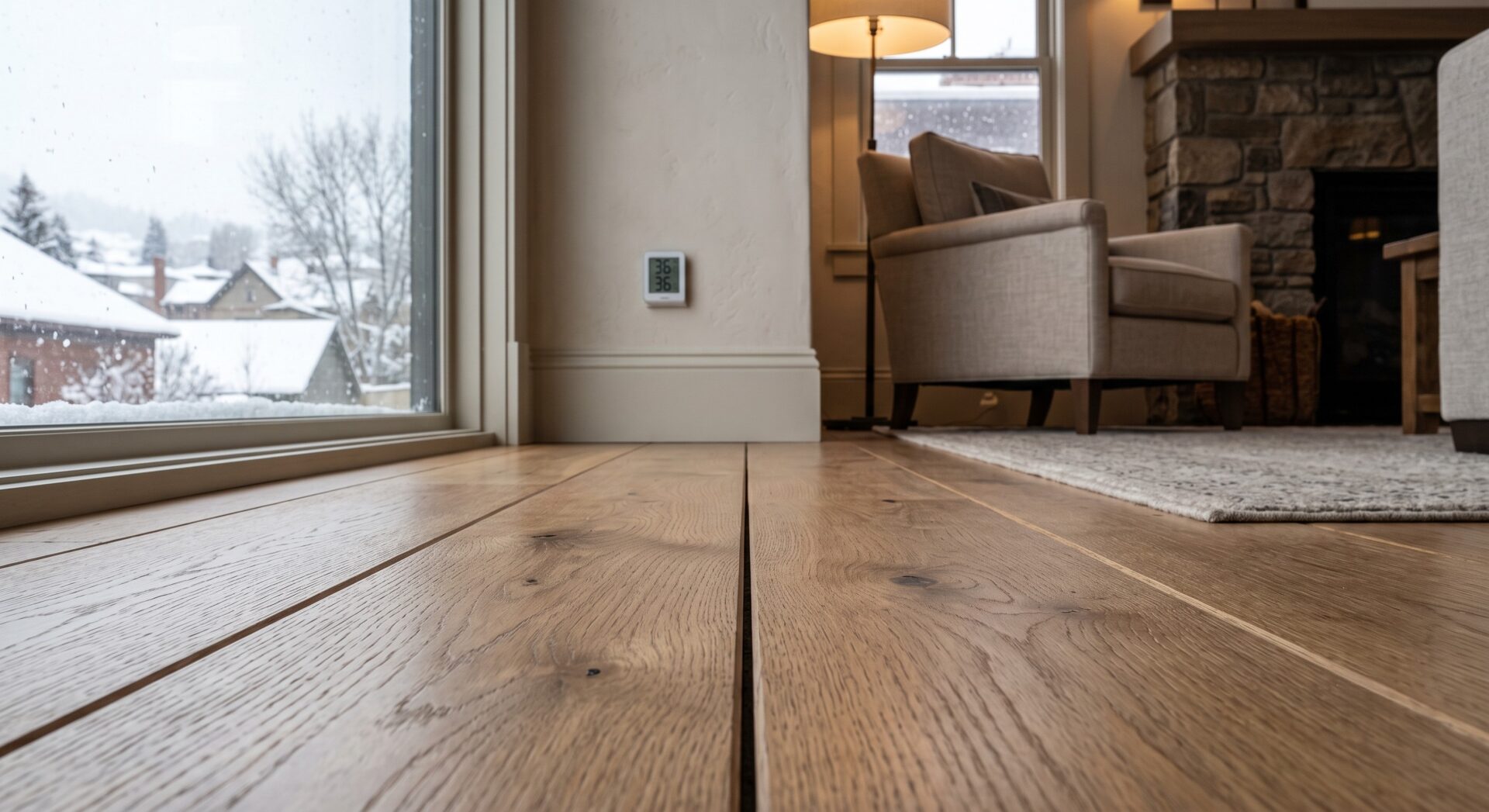
You notice it sometime in December. A thin line between two planks that was not there last spring. By February there might be several. By March you are wondering whether the floor is defective, whether the installer did something wrong, or whether you need to spend money fixing a problem you did not budget for. In most Butte homes, the answer is simpler: the floor is doing what wood does in a dry, heated environment. Understanding why gaps happen here, and what separates movement that is worth monitoring from movement that warrants a call, can save you a lot of unnecessary worry and expense. The team at Pierce Carpet Mill Outlet at 800 Dewey Blvd in Butte hears this question every winter. Call (406) 494-3313 or bring a photo to the showroom for an honest read.
Key Takeaways
- Winter gaps in hardwood floors are usually normal seasonal wood movement, not a defect. Wood shrinks as indoor humidity drops and expands again when humidity returns in spring.
- The National Wood Flooring Association recommends keeping wood floors between 30 and 50 percent relative humidity year-round. In Butte’s semi-arid climate at 5,538 feet, forced-air heat routinely pulls indoor RH below that range from October through April.
- Gaps that open in winter and close by mid-summer are expected behavior. Gaps that don’t close, grow wider year over year, or appear in a floor less than two years old and don’t recover warrant professional inspection.
- Engineered hardwood handles Butte’s dry winters significantly better than solid wood. Its cross-grain construction resists moisture-driven dimensional change. Kahrs and Hallmark engineered lines are carried at the Pierce Butte showroom.
- A whole-home humidifier integrated with your HVAC system is the most effective way to reduce seasonal gap visibility in Butte. It narrows the humidity swing; it does not eliminate movement.
Why Do Hardwood Floors Gap in Winter in Butte?
Wood is a hygroscopic material, meaning it continuously absorbs and releases moisture in response to the relative humidity of the surrounding air. When the moisture content of the wood drops, the boards shrink across their width and gaps open between them. When moisture returns, the boards expand and the gaps close. This is not a flaw in the wood or the installation. The National Wood Flooring Association explicitly describes winter gaps that close by summer as expected, normal seasonal behavior.
Butte amplifies this effect for two reasons that most flooring guides do not account for. First, the city sits at 5,538 feet in a semi-arid zone with only about 16 inches of annual precipitation. The outdoor air is naturally drier here than in most of the country. Second, forced-air heating systems, which most Butte homes rely on through a seven-month heating season, pull additional moisture from the indoor air as they cycle. The combination routinely drops indoor relative humidity to 15 to 25 percent during peak heating months, well below the NWFA’s recommended range.
The gap you see in February is the floor responding to that dryness. It is wood doing exactly what wood does.
When Are Hardwood Floor Gaps Normal, and When Should You Call Someone?
The distinction that saves money: seasonal movement is a humidity conversation. Permanent gap growth is a different conversation.
These gaps are normal in a Butte home:
- Gaps that appear during heating season (October through April) and are noticeably reduced or closed by mid-summer.
- Small gaps along the length of the board, especially in older homes with solid strip flooring.
- Slightly wider gaps in wide-plank floors than in narrow strip floors — wider boards have more fiber to react.
- Gaps that have been consistent in size and behavior for multiple years running.
These gaps warrant a professional inspection:
- Gaps that open in winter and do not meaningfully close by July or August.
- Gaps that grow wider year over year, even slightly.
- Gaps in a floor installed within the last two years that do not recover by summer. This can indicate improper acclimation before installation or a subfloor moisture issue.
- Gaps accompanied by cupping (boards curving upward at the edges), cracking along the face of the board, or finish separation. These suggest something beyond normal movement.
- Gaps that developed suddenly after a plumbing leak, wet mopping, or flooding event.
Pro Tip from Robyn Alley, Pierce Carpet Mill Outlet Butte:
Bring a photo of your gaps in February and another from July. Side by side, those two photos tell us most of what we need to know. If the summer photo shows significant recovery, you have a humidity story. If the gaps look the same in both seasons, that is worth looking at more closely. Either way, we will give you a straight answer before suggesting anything.
How Does Butte’s Climate Make Wood Floor Gapping Worse?
Most national flooring guides describe winter gapping as a common seasonal inconvenience. In Butte, it is a more pronounced version of the same phenomenon, for reasons specific to this city.
The outdoor air at 5,500 feet carries less moisture than lower-elevation environments to begin with, and Butte’s 16-inch annual precipitation places it firmly in semi-arid territory. When that already-dry outdoor air enters a home and gets heated to 68 or 70 degrees Fahrenheit, its relative humidity drops further. A whole-home HVAC humidifier is not a luxury item for wood floors in Butte; it is the primary management tool.
The heating season itself is also exceptionally long here. Butte homeowners run heat from October through May, sometimes into June. That means the floor spends more months per year in the low-humidity state than floors in milder climates, which accumulates stress on wood over time. It is one reason Pierce’s Butte team leans toward recommending engineered hardwood over solid in most residential installs.
“Recently I contacted Pierce Flooring in Butte. Robyn Alley came to my home with ample samples of laminate boards. Robyn was very professional and very well educated about the products she was showing. Products were chosen and she was very knowledgeable about all aspects of the laminate. Robyn took excellent measurements and ultimately a date was set for installation. When the day arrived, the installation crew, Josh, Mike and Paul arrived on time and immediately began the process of tearing out old carpet and laying down the new laminate. They were extremely knowledgeable and replaced approximately 2,000 square feet of carpet with high quality laminate. The work was beyond reproach. The finished job was nothing less than spectacular. I recommend these gentlemen to install your new floors when you chose Pierce to do the job! Again, one thousand percent satisfied.”
Butte Homeowner, Butte – Laminate installation, approx. 2,000 sq ft (Robyn Alley + crew Josh, Mike & Paul)
Which Wood Floors Handle Butte’s Dry Winters Best?
Choosing the right wood for this climate starts with understanding what drives movement. Wood expands and contracts across its width, not its length. Narrower boards move less visibly than wide boards. Species with lower dimensional change coefficients handle humidity swings with smaller gap changes.
Engineered hardwood is the right wood choice for most Butte homes. Its cross-grain construction — a real wood face over a layered core — resists moisture-driven movement much better than solid wood. The gaps still open and close with the seasons, but the magnitude is smaller and the risk of serious failure (cracking, cupping, delamination) is significantly reduced. Kahrs and Hallmark engineered lines, carried at the Pierce Butte showroom, are both manufactured with dry-climate performance data. Ask to see those specs when you are comparing products.
Solid hardwood is a viable choice but requires more active humidity management. If you want solid wood in a Butte home, a whole-home humidifier is not optional. The narrower the plank, the lower the seasonal gap risk. Species like hard maple and red oak have well-documented, predictable movement characteristics. Exotic species with unusual dimensional change behavior need extra vetting for high-elevation, dry-climate installs.
| Wood floor type | Gap risk in Butte winters | Management approach |
| Engineered hardwood (Kahrs, Hallmark) | Low to moderate. Best dry-climate choice | NWFA humidity range; glue-down preferred on slab |
| Solid hardwood, narrow strip (2.25″) | Moderate. Predictable seasonal movement | Whole-home humidifier; consistent 30-50% RH |
| Solid hardwood, wide plank (5″+) | High. More fiber = more visible gap change | Humidifier essential; species selection critical |
| Laminate (waterproof core) | Low. Synthetic core resists moisture movement | Keep seams tight at install; avoid wet mopping |
| LVP and vinyl plank | Minimal. No wood fiber to react to RH | Best dry-climate stability; no humidity management needed |
What Can You Do to Reduce Winter Gaps in Butte?
You cannot stop seasonal wood movement entirely, and you should not try to. The goal is narrowing the swing, not eliminating it. These steps make a real difference:
- Install a whole-home humidifier on your furnace. This is the single most effective tool for Butte wood floors. A unit that integrates with your HVAC system maintains consistent indoor humidity through the heating season with no daily maintenance required.
- Target 30 to 50 percent indoor relative humidity year-round. An inexpensive digital hygrometer from any hardware store tells you where you are at any moment. Below 30 percent, your wood floor is losing moisture. Above 50 percent, it is gaining it.
- Never wet-mop wood or laminate floors. A damp mop is sufficient. Standing water and repeated wet cleaning accelerate moisture uptake at joints and edges.
- Do not fill winter gaps with wood filler or caulk. If the gaps are seasonal, they will close by summer and push the filler out, which damages the finish. Fill only gaps that have been stable and closed for a full year.
- Keep the thermostat consistent. Large daily temperature swings amplify the wood movement cycle. A consistent interior temperature reduces short-term fluctuation on top of the seasonal pattern.
“They did a wonderful job on our house. Showed up a day earlier than promised and completed a day sooner. I will definitely be using them again very soon.”
Butte Homeowner, Butte – Flooring installation
Frequently Asked Questions
Why do hardwood floors get gaps in winter?
Wood is hygroscopic, meaning it absorbs and releases moisture in response to its environment. When forced-air heat runs through winter, indoor relative humidity drops and wood releases moisture, shrinking across its width and opening gaps between boards. In Butte’s semi-arid climate at 5,538 feet, indoor RH can drop well below 30 percent during heating season, which is below the National Wood Flooring Association’s recommended 30 to 50 percent range. Gaps that open in winter and close by mid-summer are normal seasonal movement.
Are winter gaps in hardwood floors a defect?
Usually not. Gaps that open in winter and close by summer are normal seasonal wood movement, and the NWFA explicitly describes this as expected behavior. Gaps that do not close by mid-summer, grow progressively wider year over year, or appear within the first two years of installation and do not recover warrant a professional inspection. At that point the issue may be a subfloor moisture problem, improper acclimation before installation, or a ventilation issue, not normal wood movement.
Will a humidifier stop gaps in my hardwood floors?
A whole-home humidifier integrated with your HVAC system is the most effective way to narrow the seasonal movement range and reduce gap visibility. It reduces gaps; it does not eliminate them in Butte’s dry climate. The goal is keeping indoor relative humidity between 30 and 50 percent throughout the heating season. Portable room humidifiers help but require consistent refilling to maintain that range.
Is engineered hardwood better than solid hardwood in Butte’s dry climate?
Yes, in most cases. Engineered hardwood’s cross-grain layered construction resists moisture-driven dimensional change significantly better than solid wood. It still moves with humidity swings, but the movement is smaller and the risk of serious gapping, cupping, or finish damage is much lower in Butte’s low-humidity winters. Brands like Kahrs and Hallmark publish dry-climate performance data for their engineered lines. Solid hardwood is still a viable choice but requires more active humidity management.
Do wide-plank hardwood floors gap more in winter?
Yes. Wider boards contain more wood fiber across their face, so more dimensional change occurs with the same humidity swing. A five-inch plank moves more visibly than a three-inch plank under identical conditions. Wide-plank floors are not a bad choice in Butte’s dry climate, but homeowners should choose species with lower dimensional change coefficients and go in understanding that winter gap visibility will be greater than with narrow strip flooring.
Get an Honest Second Opinion at the Pierce Butte Showroom
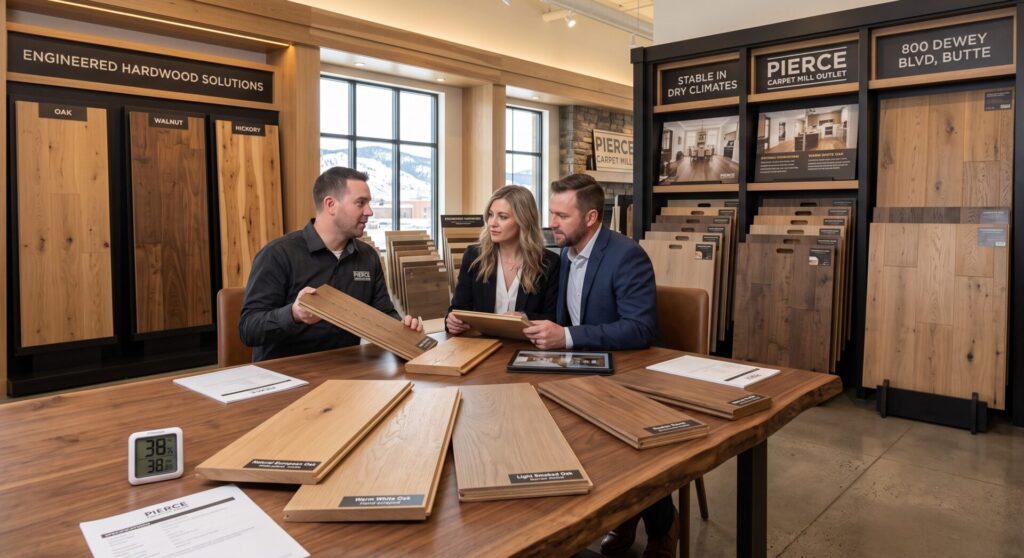
Winter floor anxiety is one of the most common reasons Butte homeowners walk into our showroom on Dewey Blvd. Nine times out of ten, the gaps they are worried about are seasonal. The other times, catching the issue early saves real money. Either way, the conversation is worth having before you authorize any repair work. Pierce Carpet Mill Outlet is at 800 Dewey Blvd in Butte, open Monday through Friday 8:30 a.m. to 6:00 p.m. and Saturday 9:00 a.m. to 5:00 p.m., or call (406) 494-3313. Our Butte team, including Robyn Alley and Matt Loeffler, has been helping this community navigate wood floor questions since Pierce Carpet Mill Outlet joined Montana’s largest family-owned flooring network, which has been in operation since 1924. We are a member of the National Floorcovering Alliance, and all our installations are backed by the Pierce Promise single-point warranty program.
If you are thinking about replacing wood floors and want to start with the right product for Butte’s climate, use the Roomvo room visualizer to preview engineered hardwood options in a photo of your own room before you visit.
You Might Also Like
-
- Flooring
October 13, 2026
How Do You Know When to Replace Carpet? 7 Signs Butte Homeowners Should Not Ignore
-
- Flooring
October 7, 2026
What Is the Best Waterproof Flooring for Kitchens? A Bozeman Buyer’s Guide
-
- Flooring
October 6, 2026
Nylon vs. Polyester Carpet: Which Fiber Lasts Longer in a Busy Montana Home?
Looking for Great Flooring Deals & Expert Service?
Save Big With Montana’s Trusted Flooring Experts